Microsoft Advertising has unveiled a series of new generative AI tools for advertisers.
The new features, Conversational Ad experiences, Ads for Chat API, and Copilot, are part of the tech giant’s mission to transform search and advertising with generative AI.
Here’s a recap of the big announcements to come from Microsoft’s Surface and Copilot event in New York…
1. Compare and Decide Ads
Microsoft is rolling out a series of fresh ad formats tailored specifically to the Bing Chat experience, starting with its newest ad product, Compare and Decide Ads.
The new format will allow online shoppers to compare different products using criteria they find most valuable.
Compare and Decide Ads will run across all verticals that have relevant feed data, including retail, travel and auto.
Microsoft is planning to launch Compare and Decide Ads in close beta in early 2024.
2. Ads for Chat API
Microsoft has announced the first partners fir its new product, Ads for Chat API; Snapchat and Axel Springer.
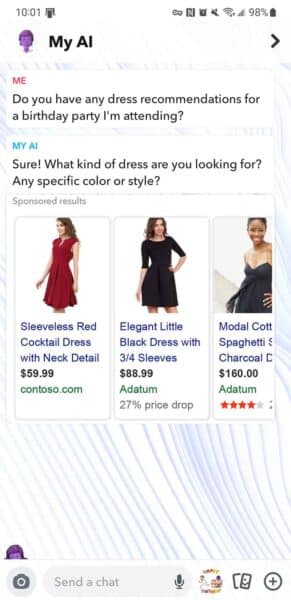
Snapchat’s My AI chatbot, which has been used by more than 150 million people worldwide, leverages the tech to serve Sponsored Links in relevant content and experiences that “feel natural to the content flow”.
Meanwhile, Axel Springer’s Hey_ product on BILD.de, powered by Microsoft Azure Open AI Services and supported by Microsoft Advertising’s Ads for Chat API, helps advertisers connect with up to 17 million daily BILD.de users.
Microsoft has said it will continue evolving its API offering based on the feedback of its advertisers and partners. Looking to the future, the tech giant is planning to welcome more partners and support their chat experience needs.
3. Copilot for Microsoft Ads
Specifically designed for advertisers and agencies, Copilot is a new tool that leverages AI to generate recommendations for product images, headlines, and descriptions.
To use it, simply describe the content you need, like an image, and Copilot will generate suggestions based on your description.
Microsoft is currently testing the new tool on a handful of advertisers but plans to bring it to open beta in the next few months.
Get the daily newsletter search marketers rely on.
Why we care. It's important to keep up-to-date with new ad products and targeting tools to ensure you are delivering the best possible user experience and reaching high-value customers.
What has Microsoft said? Kya Sainsbury-Carter, VP Global Partner & Retail Media, Microsoft Advertising, said in a statement:
"With Copilot in the Microsoft Advertising Platform, Compare & Decide Ads, and new Chat Ads partners, we are making progress in this new era of generative AI."
"Over the coming months we will share more functionality for Copilot in the Microsoft Advertising Platform and new Conversational Ad formats, as well as continuing to identify ways to democratize this incredible technology to transform the advertising industry."
"Generative AI represents a massive opportunity for all. It creates new value with real purpose. It creates opportunities for advertisers, drives traffic for publishers, and delights consumers. The era of AI is here, and we’re just getting started."
Google is going to update its Misleading Representation policy on 21 November 2023.
The search engine is planning to remove non-fulfillment of a product or service due to lack of qualifications under Misrepresentation and file it under the Unacceptable Business Practices policy instead.
Why we care. It’s vital to keep up-to-date with policy changes as violations can result in the suspension of your Google Ads account, meaning you can no longer advertise on Google.
What is the Misleading Representation policy? This policy prohibits ads or websites that mislead users by omitting important product details or presenting false information about products, services, or businesses.
The Misleading Representation policy was created to crackdown on unacceptable business practices, such as tricking users by hiding or distorting information about the advertiser’s business, product, or service. Other violations include:
Phising techniques.
Dishonest pricing practices.
Clickbait tactics.
Misleading ad designs.
Making unproven or inaccurate claims.
What is the Unacceptable Business Practices policy? The Google Ads Unacceptable Business Practices policy was created to make online shopping safe. The policy forbids the following:
Impersonating other brands.
Enticing users to part with money or information through a fictitious business.
False advertising of services that could endanger a user’s health, life, or safety.
Get the daily newsletter search marketers rely on.
What has Google said? A Google spokesperson said in a statement:
"We take violations of the Unacceptable Business Practices policy very seriously and consider them egregious."
"If we find violations of this policy, we will suspend your Google Ads accounts upon detection and without prior warning, and you will not be allowed to advertise with us again."
"If you believe there’s been an error, and that you haven’t violated our policy, submit an appeal and explain why."
"We only reinstate accounts in compelling circumstances, and when there is good reason so it's important that you take the time to be thorough, accurate, and honest."
There has been some speculation by some SEOs that Google removed certain features due to the shift to AI-powered answers in SGE. Illyes said that is not the goal, adding that it frees up Google to experiment with “other things.”
“The ultimate goal is not for AI. It is to make results that look clean. We’re not freeing up space for x or y,” he said today at Pubcon Pro in Austin.
Search results simplification. One of the three key points of emphasis in Illyes’ keynote was that Google has been removing SERP features that Google users didn’t use or find useful. That include the change to video thumbnails in April and then the recent removal of HowTo rich results and heavily reduced visibility of FAQ rich results.
Much of the discussion around Google SGE of late, and CEO Sundar Pichai’s vision for the future of Google, seems to be evolving away from the idea of 10 blue links in the next decade. Though Illyes pointed out those 10 blue links have been the only stable element on the SERPs over the past 25 years of Google’s existence.
Illyes also noted Google launches lots of “shiny things” that SEOs focused too much attention and too many resources on (e.g., Core Web Vitals). He advised being careful about planning on a long-lasting strategy around search features.
“You want to rely on 10 blue links,” Illyes said.
You can do that by writing like a human would and including associations within your content, Illyes said.
Why we care. It will be interesting to see if Google continues to remove more SERP features this year. He made a point to tell the audience to pay attention to this one in particular.
Content is king? As Google has done for 25 years, Illyes emphasized that the key to success is “publishing original, helpful content created for people.”
While content is “royalty,” Illyes said it’s important that you convince people to realize you are trustworthy and an authority on your topics. You may have some short-term success writing on basic “top of the funnel” topics, but it is not sustainable.
TikTok has launched a new tool to help advertisers better understand campaign performance and user insight.
Attribution Analytics is a first-party measurement solution that analyzes the full customer journey on the social platform, from awareness to action, providing insights into how users make purchases.
Why we care. By having a clearer picture of how customers make purchases, you can identify areas needing improvement, enabling you to create a better user experience and fuel your business growth.
New features. TikTok Ads Manager launched Attribution Analytics with a feature called Performance Comparison. This is a measurement tool that shows conversions over different timeframes, helping advertisers find the right attribution strategy for their business.
TikTok has confirmed that it is planning to release a number of additional features for Attribution Analytics in the coming months, and support other campaign types to give advertisers transparency into their ad impact. This includes:
App
Offline
Shops
And more
Performance Comparison benefits. The Performance Comparison feature is available now on Attribution Analytics and can be used to:
Analyze and compare the number of events reported under different attribution windows for key actions like View Content, Add to Cart, Initiate Checkout, Purchase, and the impact on KPIs like cost per acquisition (CPA).
Visualize the change in click-through and view-through conversions as well as your CPA across different combinations of click and view attribution windows.
Gain insights beyond current attribution settings to determine future measurement strategy.
Performance Comparison in action. The Performance Comparison tool can also be used to:
Find an attribution window that works for your business: Performance Comparison shows how different attribution windows affect key metrics, helping you choose the best window to maximize your campaign’s value.
Understand the value of TikTok views in driving conversions: Performance Comparison can assess how well TikTok views lead to view-based conversions. It provides 1-day and 7-day view-through attribution options for comparing your ad’s impact on assisted conversions.
Move beyond last-click attribution methods: Click-based conversions alone don’t capture TikTok’s full impact. Performance Comparison data fills this gap by revealing the number of conversions that occur after viewing or clicking an ad, along with the time it takes for these conversions to occur.
Onboard new measurement solutions: Use insights from the Performance Comparison tool to create a comprehensive measurement plan for your TikTok ads. TikTok provides first-party and third-party measurement solutions, allowing you to establish reliable sources of data for assessing your campaign’s performance.
What has TikTok said? Thomas Carter, Senior TikTok Strategist, Power Digital Marketing, said:
“Having visibility into extra click-through and view-through event data has made it easier to prove TikTok’s value and scale our clients’ campaigns.”
“This tool has allowed them to look beyond a standard last-click window with more confidence.”
Deep dive. Read TikTok’s Attribution Analytics announcement in full for more information.
Have you ever wondered why people click on certain search results or buy things online?
Google is always trying to understand how people search, so they’ve made many changes to how their algorithms work in the past ten years.
These algorithms don’t just follow rules; they help shape how people think and feel, which is why search and SEO are the way they are today.
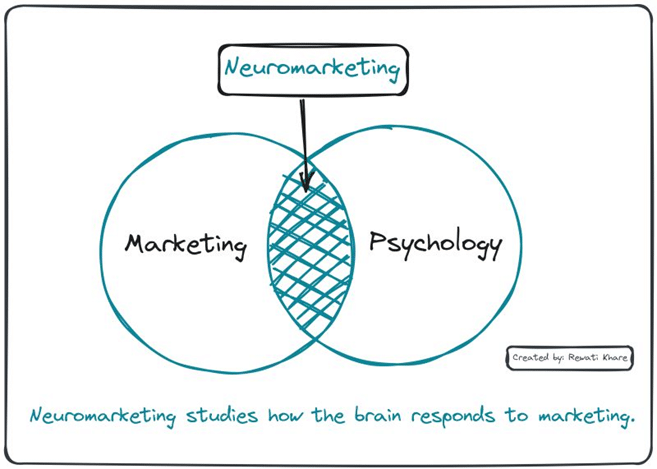
This article dives into neuromarketing – the study of how our brains react to marketing signals and how these reactions affect what we buy – and how to use it for SEO.
What is neuromarketing?
Neuromarketing is a field that studies the brain to predict and potentially even manipulate consumer behavior and decision-making, according to Harvard Business Review.
Simply put, neuromarketing is the art and science of leveraging neuroscience principles to understand how consumers think, feel and make purchasing decisions.
It helps us to understand how the brain works and gain insight into customers’ motivations, preferences and decisions.
How does neuromarketing drive consumer behavior?
Neuromarketing goes deeper than keywords and algorithms, tapping into the psychology of consumer behavior and actions.
Neuromarketing uses brain imaging, eye tracking and biometric measurement to understand how consumers respond to marketing messages.
It involves using visual and auditory cues, messages and experiences to influence how people think and act. These cues can be visual, auditory or emotional and can be used in various marketing strategies.
These mental stimuli are designed to make consumers think and react in a certain way, affecting their decisions.
Exploring the connection between brain areas and neuromarketing tactics
The consumer purchase decision process involves different brain areas, often called the triune brain model.
This concept suggests that three main areas of the brain play distinct roles in influencing consumer behavior:
Reptilian brain (The ‘old’ brain)
Responsible for basic survival functions, instincts,and automatic responses.
Plays a role in assessing safety and avoiding threats in the context of buying decisions.
Evaluates whether a product or offer meets basic needs and survival instincts.
Limbic brain (The ‘middle’ brain)
Associated with emotions, memory, motivation and social behavior.
Particularly influential in driving emotional responses to marketing stimuli.
Helps create emotional connections between consumers and products, influencing preferences and brand loyalty.
Positive emotional experiences during the buying journey can lead to stronger purchase intentions.
Neocortex brain (The ‘new’ brain)
The most evolved part of the brain.
Responsible for higher-order cognitive functions, including reasoning, language and conscious thought.
Crucial for complex decision-making and rational evaluation of options.
All of these brain regions have a part to play in influencing consumer behavior.
Knowing these brain areas and their respective functions allows you to create neuromarketing strategies that target both the emotional and rational aspects of consumer decision-making.
Get the daily newsletter search marketers rely on.
What challenges does neuromarketing solve in consumer decision-making?
The goal of neuromarketing is to uncover the mysteries of consumer behavior by concentrating on three fundamental dimensions: THINK, FEEL and MAKE.
These three dimensions are the foundation upon which successful marketing strategies are constructed.
‘THINK’
Tapping and translating brain signals.
Harnessing brain activity to understand consumer behavior.
In-depth insights and understanding of brain (neuro) reactions/responses.
Navigating through consumers’ minds to build connections.
Key neurological factors in consumer decision-making.
Example
The popular streaming service Netflix utilizes the "THINK" dimension of neuromarketing by offering multiple subscription tiers with varying features and prices.
When users are presented with these options, they rationalize to choose the tier that best aligns with their needs and budget.
Imagine a Netflix subscription with three options:
Basic plan: Standard definition, one screen at a time, at $9.99/month.
Standard plan: High definition, two screens at a time, at $13.99/month.
Premium plan: Ultra HD, four screens at a time, at $17.99/month.
The Standard plan serves as the bait in this scenario.
By positioning it between the Basic and Premium plans, Netflix nudges users toward the Premium plan, which offers more features for a slightly higher price.
At first, users may be tempted to go with the Standard plan, but the bait-and-switch effect makes the Premium plan look more appealing.
This is known as a decoy effect in marketing (a.k.a., the asymmetric dominance effect), a form of cognitive bias observed in decision-making, according to Forbes.
It occurs when a person's preferences between two options are altered by introducing a third, seemingly less attractive option.
The third option, called the “decoy,” is intentionally designed to make an otherwise attractive alternative look more appealing.
‘FEEL’
Fostering emotional connections with neuroscience.
Extracting emotional significance for branding.
Empathizing with consumers through emotions.
Leveraging emotional insights to enhance loyalty.
Example
Spotify enhances the "FEEL" dimension of the neuromarketing strategy.
Spotify creates a deep and meaningful connection beyond music by engaging users' emotions and senses.
Fostering a sense of nostalgia, excitement and emotional engagement with its platform.
Its personalized music recommendations, themed playlists and mood-based search options create a sensory-rich experience that resonates with users' emotions.
It’s an eye-catching example of what’s known as sensory marketing, which is a strategic approach that leverages the human senses to shape consumer perceptions and actions, according to Harvard Business Review.
It capitalizes on the human senses, such as sight, sound, touch, taste and smell, to create a profound and memorable brand experience.
‘MAKE’
Manipulating neurological factors for marketing impact.
Amplifying consumer engagement via neuro insights.
Knitting neuro-data to enhance marketing strategies.
Executing targeted marketing through neurological knowledge.
Example
Nike’s limited edition “Dunk” sneakers are a prime example of the “MAKE” dimension that neuromarketing is all about.
Released in a very limited number, these sneakers ignite a fire inside sneaker enthusiasts to “MAKE” a unique choice that makes them stand out.
This captures the essence of the concept known as scarcity-driven marketing. This leverages the psychological principle of scarcity to influence consumer behavior.
By creating a perception of limited availability for a product or service, this approach prompts individuals to act swiftly and decisively.
The fear of missing out (FOMO) on a unique or rare opportunity motivates consumers to make purchases, sign up, or engage with the offering to secure what is perceived as a valuable and exclusive item.
Applying neuromarketing to search and SEO strategies
The psychology of user intent
At the heart of every search lies a motive – an intent that reflects the user's desires and needs.
Tapping into users' subconscious desires makes your content more compelling and relatable. This results in higher engagement and increased time spent on your website.
When you understand how the brain processes information, makes decisions and responds to emotional triggers, you can create online environments that cater to users' subconscious desires and motivations.
A great example of this is Airbnb. By analyzing user search behaviors and preferences, Airbnb tailors its search results and recommendations to align with users' intent to find unique travel experiences.
The platform's focus on delivering personalized results triggers positive emotions related to adventure and wanderlust, enhancing user engagement and conversion rates.
Crafting landing pages that mirror user intent from search queries creates a sense of familiarity and trust.
This approach demonstrates how integrating the psychology of user intent with neuromarketing principles can lead to more effective SEO strategies and a deeper connection with the audience.
Neuro-optimized content strategy
Keyword optimization through neuromarketing-informed content strategy delves into the psychology of user intent, focusing on words that evoke emotions, trigger desires and establish connections.
Many brands adeptly use specific keywords that tap into the brain's emotional responses and desires, effectively guiding consumer perceptions and decisions through carefully crafted messaging.
Take Adidas's official tagline, "Impossible is nothing."
This tagline conveys a spirit of determination, ambition and empowerment, encouraging individuals to overcome challenges and push their limits. It aligns with the brand's focus on sports, athleticism and achieving one's goals.
You create a seamless narrative that aligns with the brain's emotional and cognitive processes by linking your brand's tagline to emotionally resonant words and desires in your content.
This connection enhances your brand's influence and fosters deeper engagement with your audience.
Adidas can use emotionally resonant language to tap into users' desires for self-improvement, achievement and confidence.
Phrases like "unleash your potential" or "achieve your best" evoke positive emotions linked to personal growth.
Using user data, Adidas can create personalized content, such as workout plans or product recommendations catering to individual preferences and goals.
Sharing user-generated content, success stories and testimonials fosters a sense of community and authenticity.
This is one of the most powerful neuromarketing messages that tap into the emotional resonance and desire of the brain.
User experience optimization (UXO) using neuroscience
User experience is at the heart of any online success. Neuroscience teaches us that swift loading time triggers positive emotions and anticipation, enhancing overall satisfaction.
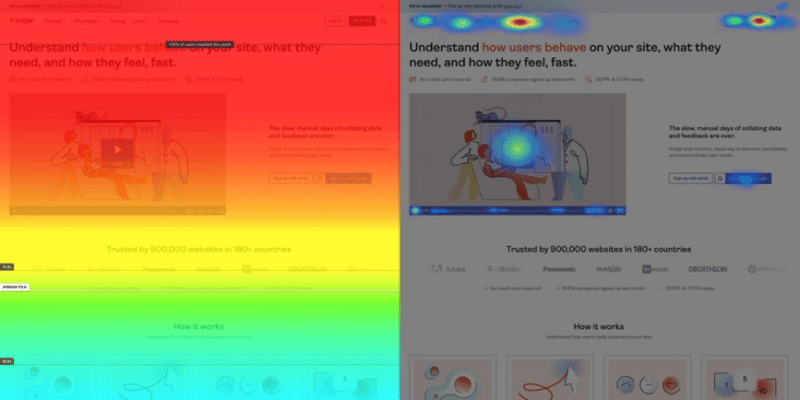
Visualize this through the lens of heatmaps, where you can witness the areas of the page that receive the most attention – a crucial insight for optimizing content placement.
Eye-tracking studies highlighted by heat maps show the natural direction that users' eyes follow.
This example from Hotjar shows how heatmaps can visualize your page content's most popular (hot) and least popular (cold) elements using colors on a scale from red to blue.
A scroll map (left) and a move map (right) on the hotjar.com homepage
Heatmaps visually represent user activity, revealing webpage hotspots of engagement and disinterest.
By analyzing these heatmaps through a neuroscientific lens:
UX designers can uncover patterns in user attention, clicks and scrolling behaviors.
These insights help refine web page layouts, CTAs and content placement to align with how the brain processes information.
Applying neuroscience-backed principles, such as the primacy effect (prioritizing what's seen first) or Hick's Law (reducing choices for quicker decisions), UXO ensures smoother user journeys, increased engagement and improved conversions.
Landing page optimization using neuromarketing
Creating landing pages that engage users intuitively, resonate emotionally and drive conversions effectively, incorporating neuromarketing principles with search strategies.
Use strategic visual cues to guide user attention on landing pages, like signposts directing a path.
Evoke emotions related to the user's needs on landing pages to establish a profound connection and influence decisions.
Providing clear and uncomplicated options aligns with the brain’s ability to process information and make decisions.
You can avoid decision fatigue and overthinking by limiting the number of options you offer.
Here is an example from the Economist.com.
This encourages faster decision-making, lessens anxiety and increases user engagement.
You direct users toward desired results by grouping related options and displaying a prominent primary CTA.
The human brain values simplicity, which makes a landing page more attractive and successful in turning visitors into customers.
Influencing behavior with calls to action
Calls to action (CTAs) are powerful tools for influencing user behavior and driving specific actions.
The principles of neuromarketing can be applied to design effective CTAs. A good CTA should be aligned with your brand’s objectives and tailored to your audience’s needs.
When creating the CTAs, it is important to use persuasive language, contrast colors and strategically place them to get people to do what you want: subscribe, download, or buy.
For example, Netflix effectively employs CTAs on its website to guide user behavior.
So, why does it work?
The distraction-free page focuses on the main CTA: to get started with the membership.
The contrasting color of the button helps users easily navigate to the next steps.
“Get Started” is a great call to action due to its clear, action-oriented simplicity, indicating what users should do next – initiate their journey with a service or product.
Additionally, regular evaluation and optimization of CTAs based on user interactions can further enhance their impact on driving desired actions.
Leveraging social proof
Social proof, a potent psychological trigger, can be harnessed through neuromarketing techniques.
When potential buyers see evidence that others have purchased and endorsed a product or service, their brains interpret it as a cue to make a similar choice.
Customer reviews, ratings, testimonials and user-generated content tap into this psychological tendency.
Amazon's "Frequently Bought Together" and "Customers Who Bought This Also Bought" features further leverage social proof.
By suggesting complementary or similar items based on the shopping behaviors of others, Amazon taps into the brain's preference for recommendations and validated choices.
People tend to follow the actions of others when making choices, driven by a need for validation and belonging.
Neuromarketing + SEO = Optimizing minds and metrics
Neuromarketing aims to uncover the secrets of perception, emotion and decision-making – the secret to digital success.
By understanding and utilizing the complex relationship between visual content, the human mind and search engines, we open up a whole new world of digital marketing that speaks directly to our audience’s hearts.
Tapping into the neuro-insights of the audience will elevate your SEO efforts to create impactful experiences that connect, engage and convert.
As the future unfolds, it's clear that the union of neuromarketing and SEO isn't just a strategy – it's a mindset, a philosophy.
It's a reminder that beyond the keywords and algorithms, the humans we serve, the minds we engage and the emotions we evoke truly matter.