Wednesday, December 21, 2022
Temples, Churches Won't Be Affected By Noise Curb Law: Goa Chief Minister

UP Boy Strangled, Buried In Cane Field By Uncle, Cousin Who Kidnapped Him
Tuesday, December 20, 2022
Man Carries Father's Gun To Party To Impress Friends, Arrested: Delhi Cops
Man Killed, 2 Sons Injured In Fight Between Groups In Maharashtra
Google Search testing search in video
Google is testing the ability to search for spoken words in a video through a new “Search in video” feature. This is officially being piloted in India, but some are also seeing this feature being tested in the United States.
The announcement. Google posted this news on the Google India blog, writing, “besides images, videos are also a rich source of visual information but it’s often hard to find something buried inside a long clip. For example, perhaps you’re watching a long video about Agra, and you’re curious if it also covers Fatehpur Sikri. With a new feature we’re piloting, you’re now able to search for anything that’s mentioned in a video, right from Search. Simply enter a search term using the ‘Search in video’ feature and quickly find what you’re looking for.”
“Use the ‘Search in video’ feature beneath a video, enter a term, and quickly find what you’re looking for within the video,” Google added.
What it looks like. Here is a video showing this feature in action:
Like Google key moments. This, at least to me, isn’t too far off from the technology Google uses for key moments in a video. Google is able to isolate what sections of a video are talking about, without even having to be fed chapters these days. Plus, with YouTube’s advanced transcriptions, it is no wonder Google Search is able to do this.
US searchers. Searchers in the United States are also seeing this feature. Glenn Gabe tweeted that he saw it as well:
Why we care. Besides this being simply cool and, for some, mind-blowing, it also shows how far search technology has come over the years. It also may mean that marketers who post videos should ensure the language used is clear and that Google is able to properly and accurately transcribe the words spoken in the video.
The post Google Search testing search in video appeared first on Search Engine Land.
from Search Engine Land https://ift.tt/nbs5JQ9
via https://ift.tt/Ey21DH0 https://ift.tt/nbs5JQ9
Customer segmentation models to improve the performance of loyalty marketing campaigns by Comarch

Creating a loyalty marketing strategy is critical to understanding that every customer is unique. Every member has different needs, preferences, communication channels, behavior and emotions. Approaching all these unique members as one via mass communication is a big mistake when trying to scale your business. Segmenting your customers is critical to your success. But what is customer segmentation, why is it important and which segmentation models should be considered?
1. What is customer segmentation?
Customer segmentation is the practice in which marketers divide their customer base into specific groups in order to deliver more effective communication and a personalized experience. These segments can be based on one or several characteristics that clients have in common, such as demographics, psychographics, preferences, or even behavior.
For example, customers can be split based on demographics such as their age, gender or location – then these characteristics can be combined with preferences such as how they want to be contacted – in addition to account history, say the number of transactions made in the last few months or their lifetime value. Segments can be as simple or as detailed and granular as you prefer.
Defining a customer segmentation strategy requires your organization to understand who your audience is, as well as their needs and behavioral tendencies. This will allow the right allocation of budget and resources to provide more personalized communication and make your business grow faster.
2. Why is customer segmentation important?
Defining a customer segmentation strategy will bring many valuable benefits to any business. Here are some examples of why customer segmentation should be a top priority:
- More effective communication
Brands that understand the importance of customer segmentation have the greatest chance of hitting their target. The messaging used for a 20-year-old female shouldn’t be the same as for a 60-year-old male. A deep analysis of your customers will lead to a more personalized experience considering the segment group and the channel they are being communicated through. Ultimately, this will translate to higher response rates and engagement.
It is also important to consider the number of times per day and days per week a customer should be contacted. Optimizing the communication time will prevent overcommunication and its potential consequence of losing the customers’ trust.
- Improve marketing ROI
Effective customer segmentation also helps in allocating internal human and capital resources. Companies can determine which groups will be more and less profitable and decide which ones deserve more or less attention. The final result – your revenue will grow while simultaneously stabilizing your customer base.
- Increase customer lifetime value
Improving the customer experience naturally leads to increased engagement. The key is to then maintain this engagement over extended periods. Some techniques to achieve this include custom offers tailored to the preferences of specific groups. This, together with recognizing their loyalty to your brand with incentives (coupons, rewards or promotions), all lead to gaining a larger share of your members’ wallets and spend.
While most brands tend to target their top-spending customers to reward them and maintain their engagement, it is imperative not to forget about your underperforming members. Those who gave the company a high benefit in the past and whose purchasing trend has dwindled over time can receive special attention to bring them back to their old spending habits
Personalizing these communications depending on loyalty segments and/or trends also improves customer service and the way the business assists in customer loyalty and customer retention.
- Product improvements
By understanding what motivates customers to buy your brand’s products, you can tailor offers to suit client needs better. This will maximize customer satisfaction and in turn, create brand ambassadors. What is better than a happy customer recommending your brand to their friends?
- Separate your brand from the competition
All the customer segmentation benefits detailed above enhance clear distinctions from your competitors and prepare your brand to adapt to any and all market changes. Clients can be impulsive, and their opinions, behavior and needs can vary often. Executing customer segmentation means being ahead of the curve in terms of upcoming trends, understanding the clients’ new priorities and adapting to them.

3. Actionable strategies to implement customer segmentation
When embarking on your customer segmentation journey, you must first ask yourself, “What is the goal?” What are your brand’s unique selling points? How many members of the marketing team will be involved? Once this is established, the focus shifts to your customer base. Some tasks could include determining the audience size, the number of potential segments needed, identifying which customer will spend more and which will spend less, etc.
Then, decide what data needs to be collected and how it will be collected. Remember that this information is crucial when creating your segments and will be the foundation of the marketing campaigns and initiatives. To execute any of these segmentation exercises, you must ensure you have access to the most important piece of it all… the data!
Data can be collected in different stages throughout the loyalty lifecycle, whether mandatory upon enrollment or optional after the fact, in the form of a survey. Now, all information received will come directly and voluntarily from clients. This is what is known as zero-party data.
What’s more, these data points can be compiled into segments. It is recommended to start with a broad focus and continuously narrow them down over time. AI and ML can do wonders in unearthing and analyzing behavior and trends, as well as shaving time and resources off the shoulders of your workforce. While defining these customer segmentation models, set up the main strategy to retain and gain customers loyalty, and after that focus on acquiring new ones.
5. Defining customer segmentation models
Customer segmentation models are the different ways in which a company decides to divide its customers. In loyalty, there is a wide spectrum of customer data points to consider, but the most relevant across the industry are:
- Demographic
Demographic segmentation is when customers are divided by their social characteristics as part of the population. Some examples include age, location, gender and birthday. - Psychographic
Psychographic segmentation considers an individual’s personality, attitudes, aspirations, interests, and values. For example, in customer segmentation for fashion, the audience can be divided depending on their size, favorite store, product, and even their concern for recycled clothes. For a Veterinary clinic, it will be more interesting to know what type of animals their clients have at home. Each industry will have very distinct data points that are more important to its unique business. - Customer behavior
Customer behavior is one of the most important attributes when building customer segments. This division will allow a deeper knowledge of customer trends, habits, and product usage. Some examples are the total amount spent on transactions, the total number of transactions, the date of the last purchase, the number of points spent in the last month, the number of redemptions completed, etc. Here is where customer engagement with the loyalty program can be measured.
Now, member activity can be tracked, and trends can be identified automatically. Thanks to artificial intelligence and machine learning, segments can be created according to customer lifetime value (CLV) trends. Just to give an in-practice example, retail customer segmentation models should focus on targeting their best performers in stores whose lifetime value is greatest, but also send out communications and promotions to those members who have had a high spend in the past, but their trend is now decreasing. - Campaign responses
Campaign response segmentation can be set up according to, for example, the way your members wish to receive communication -email, SMS, push notifications, etc.-, the channel used to enroll in the loyalty program – mobile app or web portal – or the number of referrals made to a friend. The response to the program awarding customers with different recognition tiers can be another factor to consider for segmentation. - Multiple conditions
Customer segmentation can apply to multiple different characteristics simultaneously. For instance, companies can target members by a condition as simple as membership type or by their membership in combination with their location and a purchase of a specific product. The most effective segments are as narrow and specific as possible to small groups to personalize the campaign at its lowest level.
6. Summary with CTA
Understanding your members needs, preferences and behavior is the beginning of your customer segmentation journey. Defining goals, resources, unique selling points and crucial data points will prepare your business for all segmentation possibilities. Customer segmentation helps target the right clients, who present more profitable opportunities at the right time and in the most efficient way. With it, their retention and satisfaction will be ensured, as well as the maximization of sales and revenue.
To learn more about customer segmentation models and how to build the most effective loyalty marketing strategy, request a demo with our Loyalty Experts! They will match you with an experienced Loyalty Consultant with experience in your unique market space and industry.

The post Customer segmentation models to improve the performance of loyalty marketing campaigns appeared first on Search Engine Land.
from Search Engine Land https://ift.tt/aGfPzTD
via https://ift.tt/Ey21DH0 https://ift.tt/aGfPzTD
How to set up a Google Ads account
Advertising on Google Ads is a no-brainer for many brands.
Between the mammoth market share, the proven ROI on time and monetary investment, and the innovations in creative/targeting – it’s never been a better time to scale Google Ads.
Getting started can be a bit more complex than it used to be. You’ll need to make some key decisions on what kind of account you want and make sure you have your verifications ready.
This article is a step-by-step guide to setting up your Google Ads account.
Note: While there will be some strategic advice, the goal is to keep it as universally applicable as possible. In addition, we will not be going over setting up Local Service Ads or Merchant Center.
Getting started with Google Ads
Setting up a Google Ads account requires an email (can be Google or not).
If you don’t already have an email you planned on using, you can create a quick account before the ad account is set up.
Once you designate the email account you want to be affiliated with your ad account, you’ll be prompted to use a Google Business Profile as a starting point.
However, if you do this, you’ll be locking your account into being a Smart Campaign account.
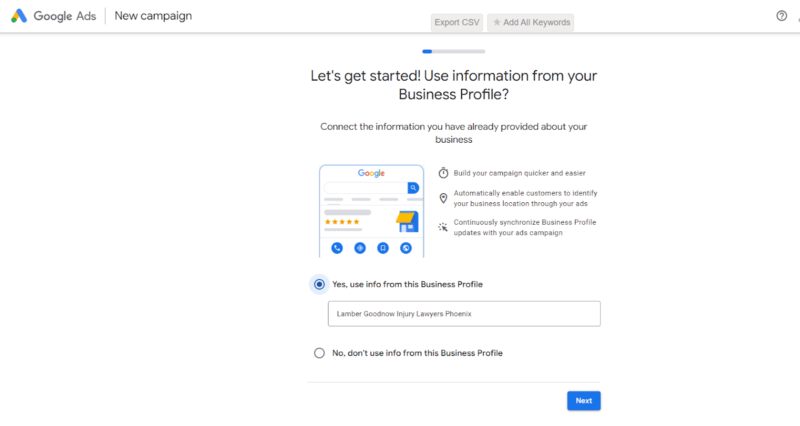
While Smart Campaigns can be useful for some brands, locking in the account to only support such campaigns is not ideal for most advertisers.
Be sure to select “Are you a professional marketer? Switch to Advanced Mode.”
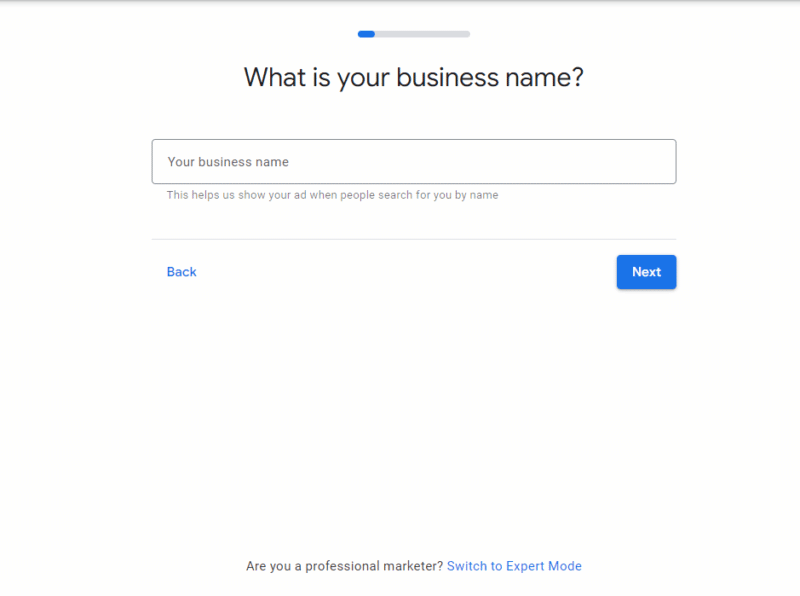
Once you’ve transitioned to a normal ad account, you’ll be prompted to create your first campaign. If you’re not ready, you can proceed to create the account without a campaign.
Google will look for assets associated with your email address (like YouTube channels). You can connect them for additional audiences and placements or leave them off for now.
If you are promoting your app or using it as a landing page, you can also connect it during this step. You’ll also be allowed to connect your phone number.
Ideally, if you’re using call tracking, you’d have that number ready. However, you can always adjust it later.
Conversion tracking is a critical part of any Google Ads account. You can choose the marketing objective of your campaign (conversions or brand lift) and set up the conversion tracking after.
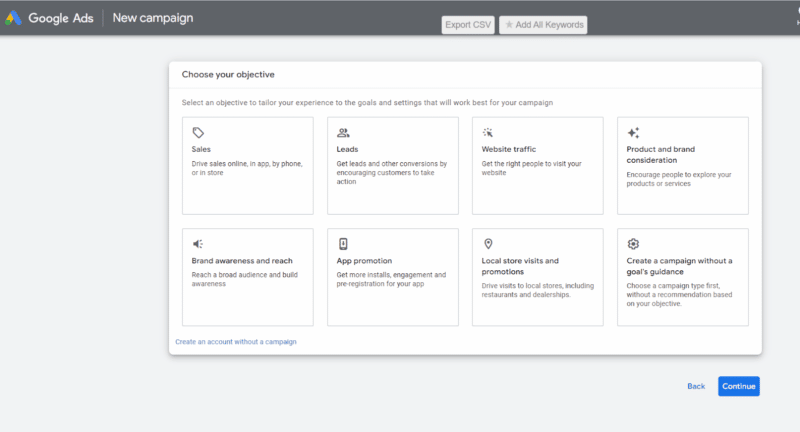
Note that you should not opt into multiple conversion goals in a single campaign.
Asking one campaign to be responsible for leads and sales will have too many variants in conversion values.
The next step is to decide if you will build a single-channel campaign or opt into Performance Max (PMax).
The campaign goals you select will influence which campaigns you are prompted to create. If you don’t select any, your options will be search and PMax.
PMax needs visual creative to succeed. If you do not have images and videos ready, it is best to start with a non-PMax campaign.
Opting for a search campaign will prompt you to begin filling in the following:
- Keywords: You can either manually enter them or get suggestions based on your site or themes.
- Search ad text: You’ll be prompted to enter headlines, descriptions, and the final URL for one responsive search ad.
- Assets (formerly known as extensions): Site links, structured snippets, callouts, calls, price extensions, promotions, lead forms, apps.
- Bidding strategy: During this stage of campaign setup, you will only be able to opt into Smart Bidding or automated bidding.
- Campaign settings: Aside from naming conventions, you’ll be able to set location targets, ad schedules, audiences, ad networks, and languages.
PMax campaigns focus on all Google Ads channels, so the lion’s share of the setup revolves around supplying creative.
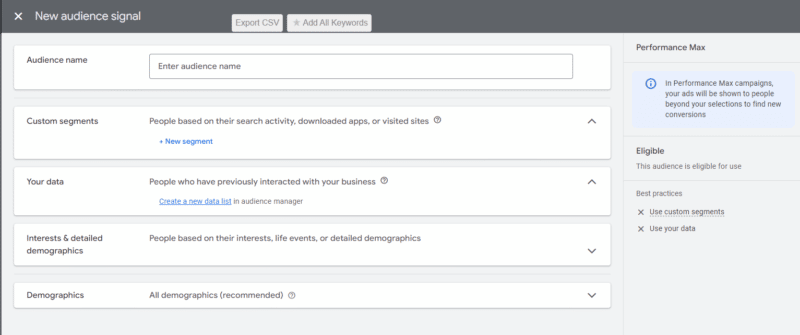
While you won’t be bidding on keywords, you can add a custom intent audience in the Audience signals.
Be sure you have video creative otherwise, Google will create a video on your behalf.
Budgets are critical to the success of your Google Ads account and campaign.
Setting one that’s too low will turn all spend into waste because there won’t be enough clicks to lead to conversions. Going too high might allow for budget misallocation.
When you set your daily budget, be sure you’re setting one that you’re OK with doubling daily. Google will attempt to make your monthly spend average out to your daily spend across 30.4 days.
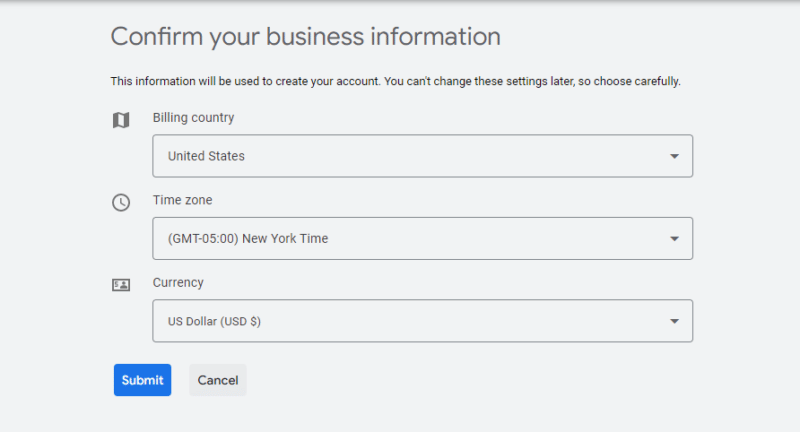
It’s important to note that your billing profile does not need to be the same as your main ad account.
For agencies, you can set up the billing profile under your client or yourself. Google Ads will take most credit cards, PayPal, and direct deposits from bank accounts.
Follow-up steps
Congratulations, your Google Ads account is set up! However, you're not completely done yet.
Once you finish the initial setup, you must verify your account and set up two-factor authentication.
Verifying your account means requesting and sending back a postcard confirming your business is real. If you do not complete this step, your ad account will be canceled.
Additionally, if you don't incur charges in the first few days of the account, you risk suspension.
A great way to mitigate this is to link your Google Ads Console to Google Analytics.
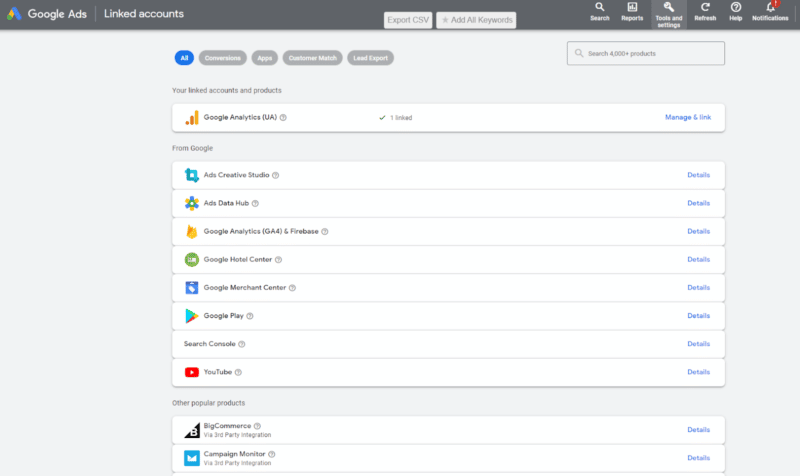
Setting up conversion tracking doesn't need to be a code-heavy experience. Codeless options include:
- Connecting your conversion tracking with Google Tag Assistant.
- Copying your conversion tracking code into your site's analytics section.
You can also send conversion tracking setup to your developer.
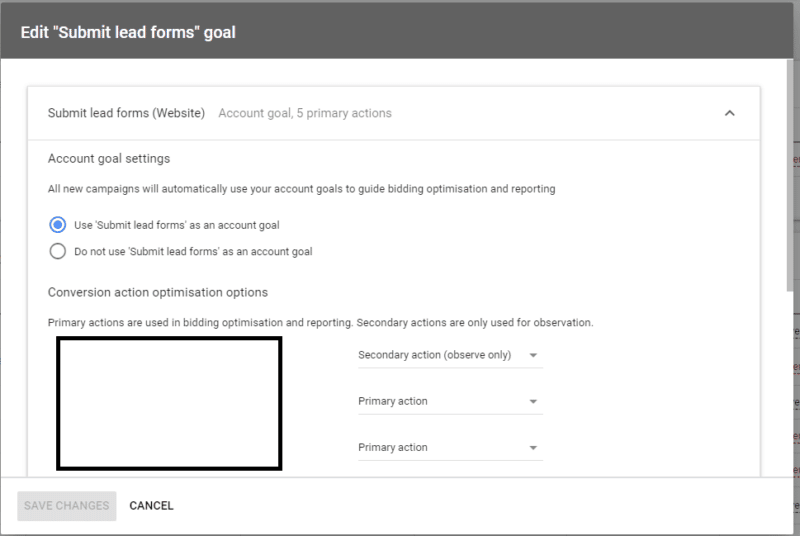
Conversion actions will either be primary or secondary actions.
- A primary action will factor into reporting and the Google Ads algorithm.
- Secondary actions will just report the data and are not factored into cost per acquisition (CPA).
Setting up your Google Ads account
Campaign structure and ad creative choices can be part of account setup. However, if you're not ready, do not force the first campaign.
Make sure you're setting yourself up for success by having your linking accounts ready (Analytics and Search Console) and your creative on hand.
The post How to set up a Google Ads account appeared first on Search Engine Land.
from Search Engine Land https://ift.tt/nd0zgxF
via https://ift.tt/WXsMBaJ https://ift.tt/nd0zgxF