Saturday, March 23, 2024
Smriti Irani Corners Rahul Gandhi Over His Stand On Arvind Kejriwal

Friday, March 22, 2024
"Gangs Run From Jail, Not Government": BJP Shreds AAP's Atishi For Remark
Google SGE a top threat to brand and product terms, study finds
You should expect to see “some erosion of current traffic levels” from brand-related terms as a result of Google’s Search Generative Experience, according to a new Authoritas analysis.
Why we care. Google just today announced it is rolling out SGE to users who aren’t opted into Search Labs, under the name of AI overviews. We’re still in the dark about how large of an impact the AI-generated answers will have on organic traffic. And, as Authoritas put it in their analysis:
- “These new types of generative results introduce more opportunities for third-party sites and even competitors to rank for your brand terms and related brand and product terms that you care about.”
Google SGE displayed for 91.4% of all search queries. Only 8.6% of keywords in this analysis did not have an AI-generated response.

Quora doing well in SGE. Question-and-answer site Quora finished “in the top 20 performing generative domains in 11 of 15 categories,” according to Authoritas.
Wikipedia was another winner, appearing in the top 20 for every category – including being the top or second-best performing domain in 11 of the categories examined.
SGE links. On average:
- 10.75 links appeared in SGE answers.
- 4.3 unique domains were featured per answer.
- 62% of generative links came from sources outside the top 10 ranking organic domains.
- 20.1% of generative URLs directly matched a page 1 organic URL and 17.9% showed a different URL from the same organic ranking domain.
PPC ads. Just over 50% of keywords had paid search ads. Those ads appear above SGE 51% of the time and beneath 49% of the time, on average. Here’s a chart showing a more nuanced breakdown by industry:
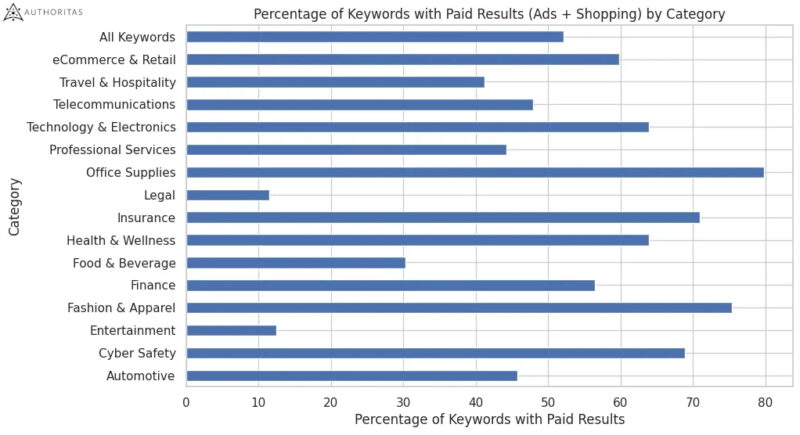
Shopping Ads, meanwhile, appear below SGE 64% of the time, on average.
About the Analysis. It looked at 2,900 keywords for 251 prominent U.S. brands across 15 industry verticals. You can read it here: SGE Research Study – The Impact of Google Search Generative Experience on Brand and Product Terms
Dig deeper:
- Google SGE testing and development is ongoing, growing
- 94% of Google SGE links are different from organic search results, study finds
- Google SGE impact by industry and emerging features
- New Google SGE insights: Content formats, YMYL, product views
- How Search Generative Experience works and why retrieval-augmented generation is our future
- Preparing for Google SGE: Essential guide for marketers
- How Google SGE will impact your traffic – and 3 SGE recovery case studies
- Google patent describes how the Search Generative Experience works
from Search Engine Land https://ift.tt/kBQuIbl
via https://ift.tt/lK3wgxt https://ift.tt/kBQuIbl
Thursday, March 21, 2024
Turbulence ahead: The wrath of the March 2024 core update is not linear
SEOs are already speculating about which update did what to which sites (the March 2024 core update or March 2024 spam update) and what sites should or shouldn’t be doing.
This is a bit dangerous.
Meanwhile, Google is urging SEOs to be patient and to let this thing play out. Google isn’t yanking your chain. There is a ton of volatility and a ton of reversals happening at the moment.
While what I’m about to share is purely anecdotal, I’ve been diving into the nitty gritty of these updates for a while now.
Here’s what I’m seeing. Hopefully, it will help give the March 2024 core update a bit of context as we wait this thing out.
March 2024 core update catch-up
Google said the March 2024 Update is going to be prolonged and that there will be “more fluctuations in rankings than with a regular core update.”
The first big spike in rank volatility was picked up on March 9. Since then there have thus far been two additional peaks, on March 15 and 19.
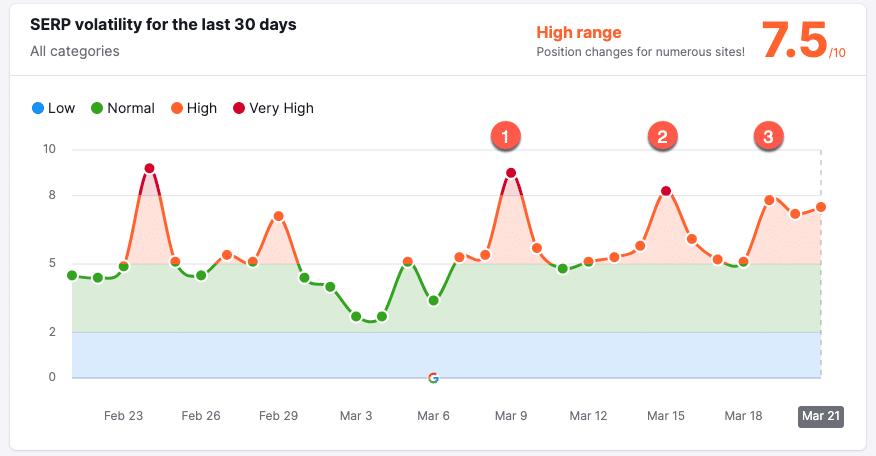
However, that doesn’t mean that with each “sub-spike” comes a “fresh set” of ranking movements. It’s not only very common but basically the rule that the secondary spikes within a core update will present an extensive set of reversals to the rank changes initiated at the forefront of the update.
How many times have you seen a site “win” at the start of the update only to get clobbered towards the end of it?
With the March 2024 core update, you’re going to most likely see various sets of reversals as the update is both longer and more complex than usual.
An absolute heap of rank reversals
No, not every bit of the rank volatility we’re seeing with the March 2024 core update is a reversal. Sites are going up and sites are going. Some of those rank trajectories will ultimately reverse themselves and some of them will stick.
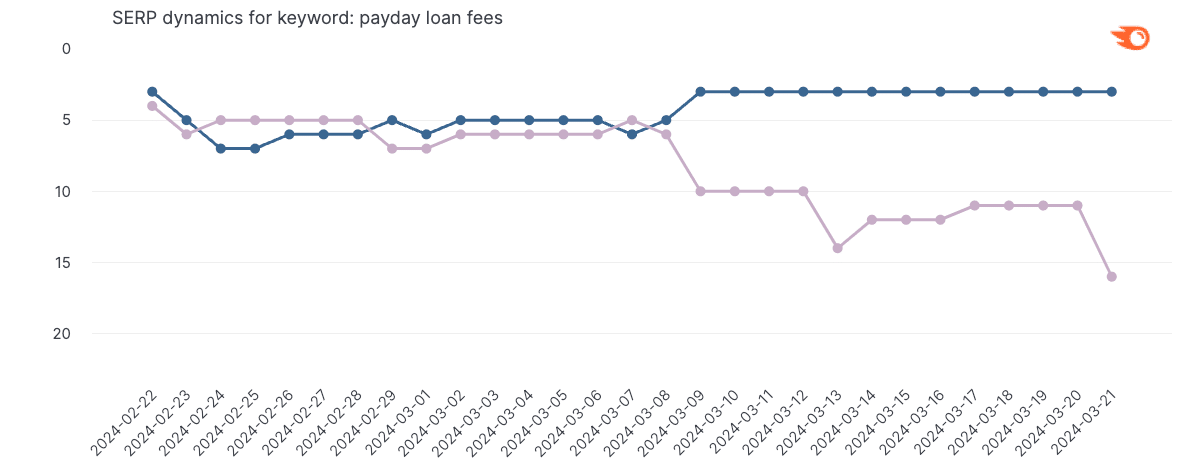
In the above, the most recent “sub-spike” in volatility further didn’t reverse anything, it accentuated the URL’s initial ranking loss.
Caveats aside, there has been a noticeable amount of reversals with the sub-spikes in fluctuations seen on March 15 and 19.
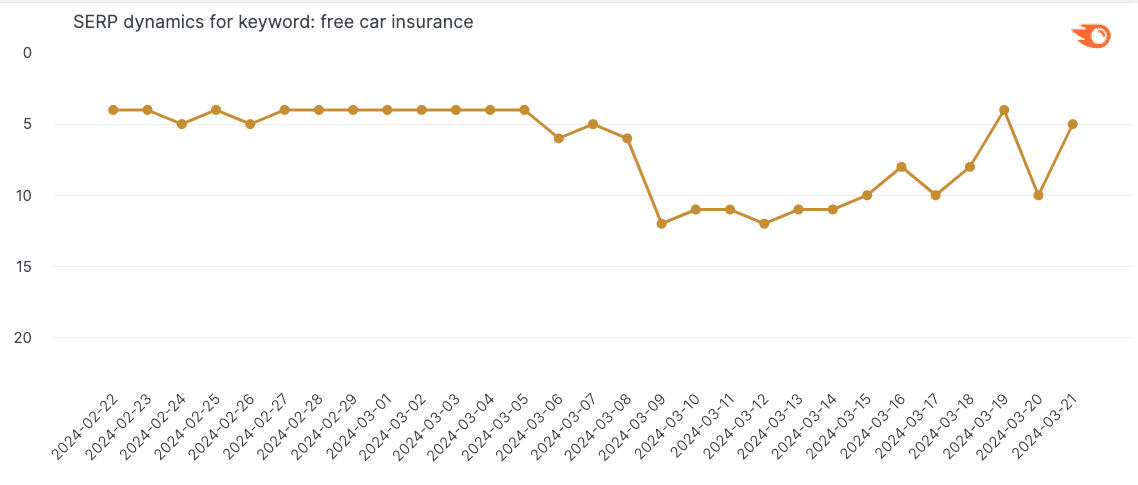
Here’s a case of Allstate losing rank for the keyword free car insurance. When I saw the initial hit in rank the domain took on March 9 for the keyword it was, obviously, surprising.
Lo and behold, there was a bounce back on March 19 followed by a loss on March 20 only to see yet another bounce back on March 21.
Here’s mousesavers.com showing a pre-update spike (parenthetically, very common to see sites showing sharp rank changes before an update and then subsequent reversals):
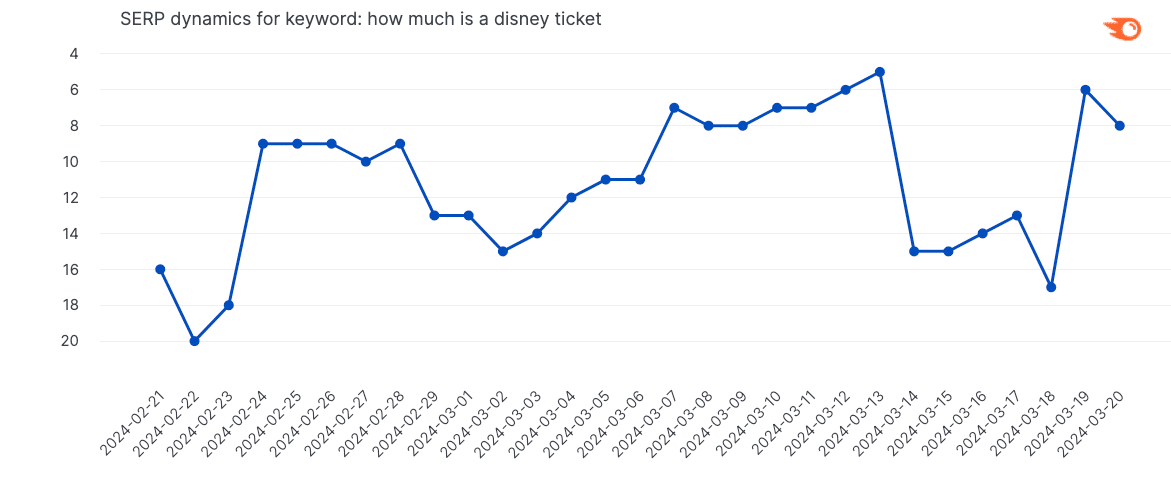
You can clearly see the early volatility spike of the March 2024 core update reverse the pre-update surge. However, just a few days later the downtrend was reversed.
You can see the same pattern play out at the domain level in this case:
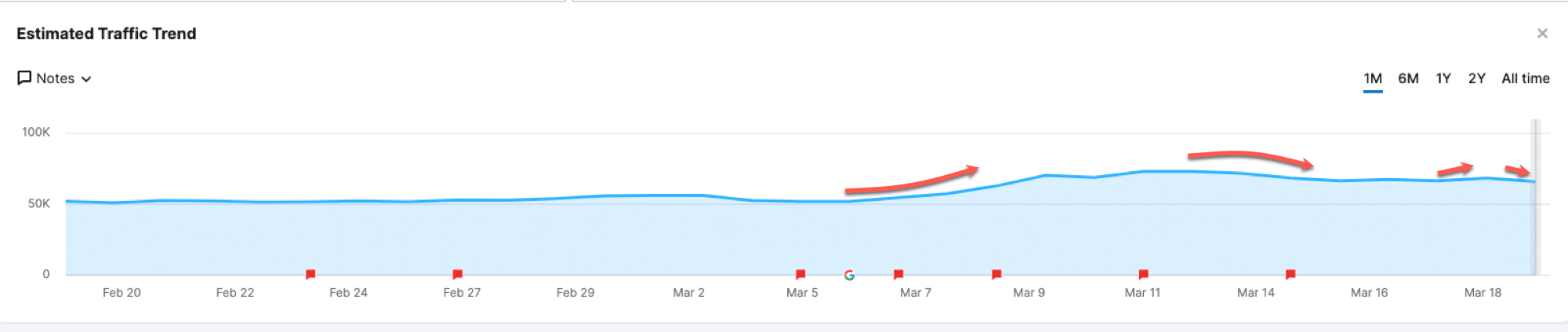
As aside, this site sports one of the worst UX’s I’ve seen in a long time. It’s nostalgic in a sick way.
At the same time, it does appear to offer a wealth of information. One could speculate (greatly) that the reversals are a battle between UX and content (or perhaps, they’re just reversals without much deeper meaning at this point).
In the case of the Illinois Department of Public Health’s rankings for the keyword risk factors for oral cancer, the reversals had the site fall completely out of the top 20 for two days:
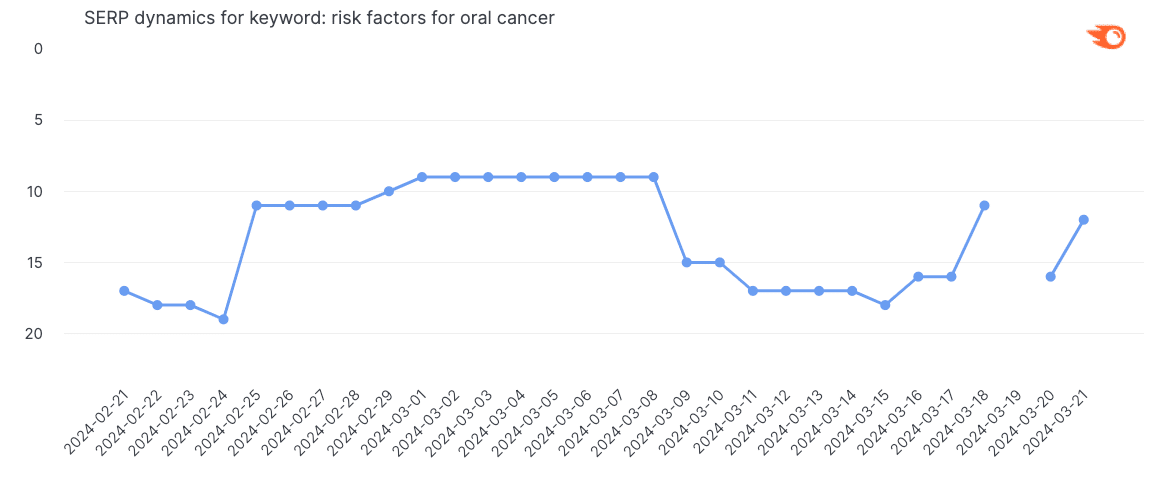
After seeing a reversal on March 18 the site fell out of the top 20 altogether on March 19 and then again on March 21.
For the record, not all reversals are full-on restorations of rank. In the case of this dentistry site, the ranking losses seen at the onset were reversed on March 19 but the site is only halfway back up the SERP relative to its previous rank.
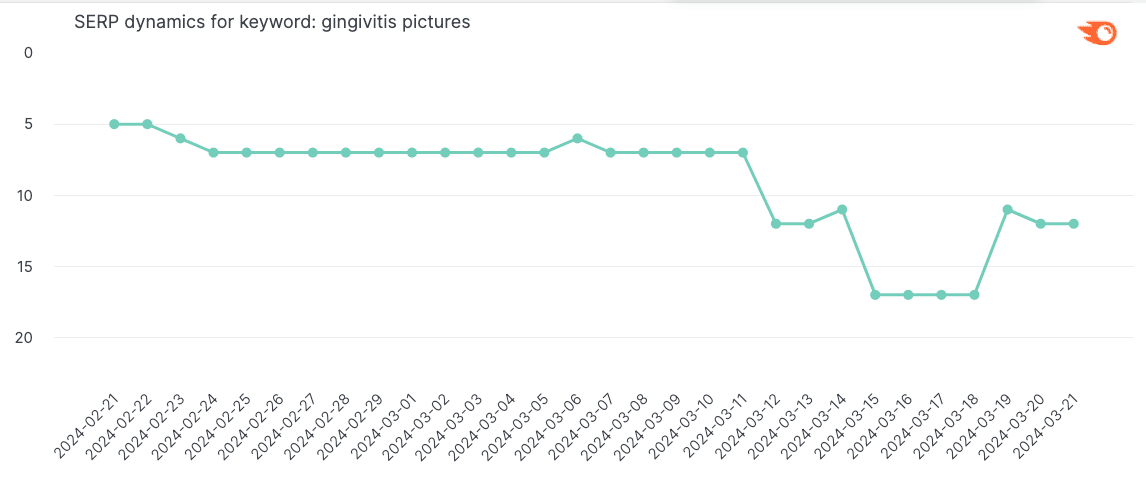
At the domain level, the reversal on March 19 did put it back a bit closer to previous performance:
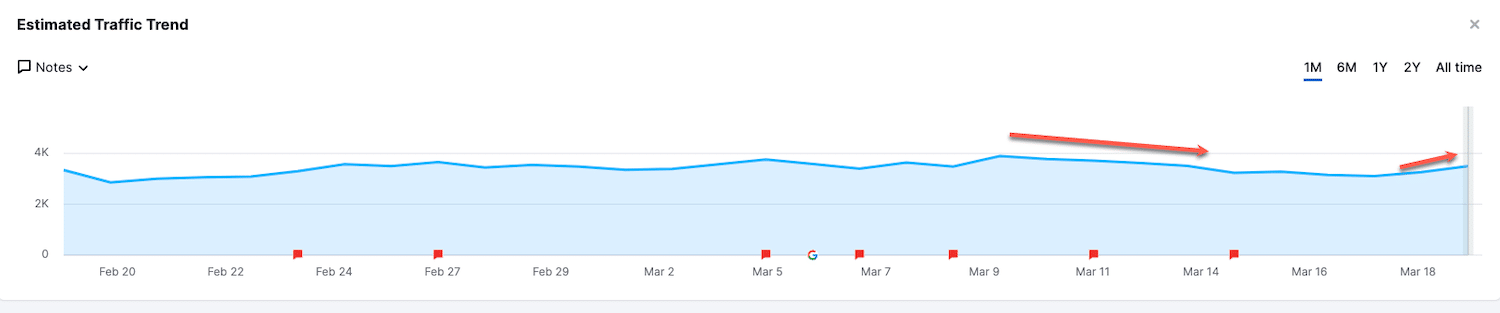
Same deal for a reversal that causes a ranking loss.
As in the case below, just because the reversal shows a loss doesn’t mean that the ranking loss puts the URL back at square one… yet (or not, who knows at this point!).
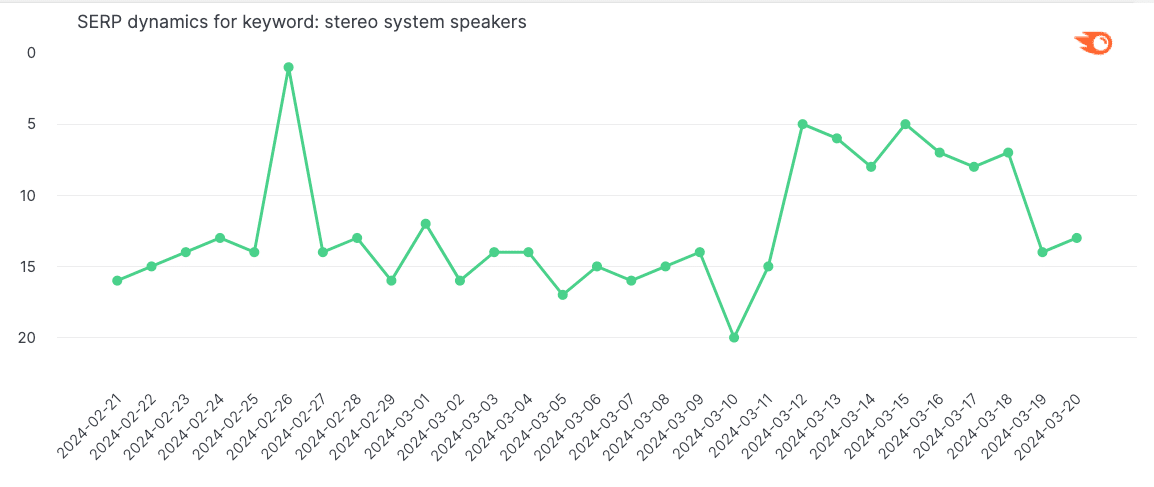
I could go on and on with these cases forever but then my children would have an absent father and no update is more important than your kids (SEO life lesson right there).
Some odd volatility
Aside from the more traditional reversals I’ve seen some just downright weird behavior. It’s entirely pervasive but it’s certainly a more common pattern than in previous core updates (at least that’s what I have seen).
Check this one out:

You might be asking yourself, “What the hell am I looking at?”
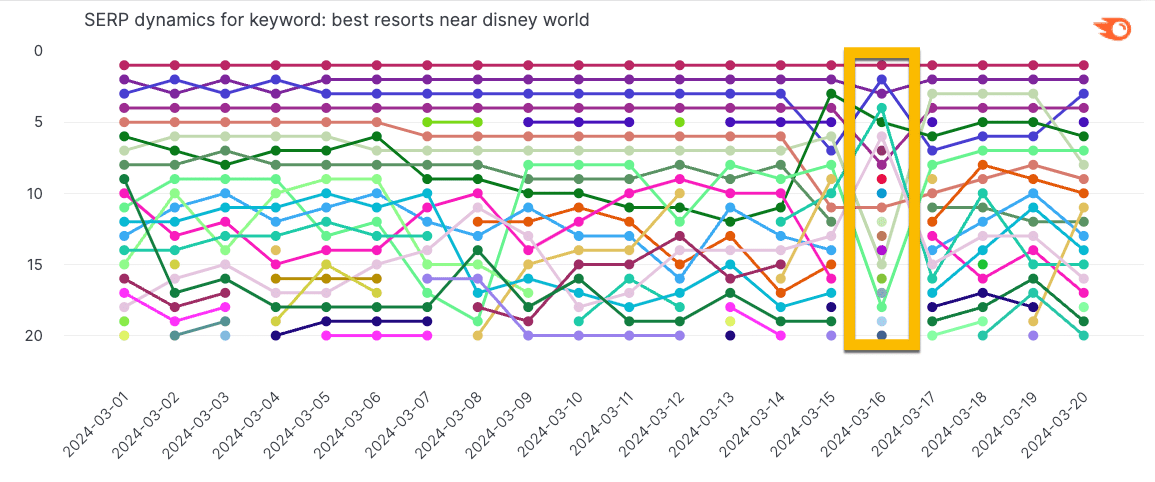
You’re looking at Google basically replacing the entire set of results from at least position 20 and up.
A connecting line means a continuation of rank above position 20 from one day to the next.
I only count four such lines within the image above (though, I’ve never been very good at counting).
In fact, you see this pattern take hold over three days. Meaning, Google reshuffled almost the entire SERP not once, not twice, but three times. Many of the URLs ranking on March 18 disappeared on the 19th and some remerged on the 20th.
I’ve seen this before. However, I’ve generally seen it for cases where the SERP is filled with YouTube URLs and Google is shuffling them around day after day after day. This is not such a case.
It’s not a one-off either. I’ve seen this pattern a few times already.
Here’s another similar (if slightly less severe) instance:
This thing isn’t over – take it slow
What’s my point with all of this?
This is a long and volatile update.
As I said earlier, Google isn’t yanking your chain by saying to remain calm and have patience.
I would assume you’ll see some of the sites and pages I showed here to see numerous more reversals by the time this thing is all said and done.
The same with your or your client’s sites. It’s way too early to try to pin this thing down and have an understanding of where you stand.
So despite me not being that old to actually remember it, this catchy slogan still applies as the March 2024 core update continues to roll, “buckle up for safety, buckle up, always buckle up.”
from Search Engine Land https://ift.tt/QMdwYJH
via https://ift.tt/vSpsJry https://ift.tt/QMdwYJH
Google Analytics 4 addresses Google Ads report discrepancies with conversion update
Google Analytics is shifting from tracking conversions to using “key events” for behavioral analytics, aligning its definition with Google Ads platforms.
This update ensures that what constitutes a conversion will be consistent and easily comparable between Google Ads and GA4 reporting, providing marketers clearer insights into user behavior across platforms.
What’s changing? In GA4, legacy conversions will now be referred to as key events. These events represent crucial actions for behavioral measurement in your business. Additionally, conversions in the report and explore modules will be transitioned to key events, maintaining the same measurement capabilities as the legacy conversion concept. Key events will be considered conversions only when shared with Google Ads, ensuring accurate performance reporting.
Cross-channel reporting. Additionally, the Advertising workspace in GA4 will introduce new cross-channel conversion performance reporting, extending beyond Google Ads. This section will serve as your central hub for monitoring Ads conversion performance, providing comprehensive insights across various advertising channels.
What Google is saying. Kamal Janardhan, Senior Director of Product Management, Measurement, at Google, said in a statement:
- “In this improved, more unified experience, we are addressing the differences in conversions reporting that marketers have experienced across Google Ads and Analytics, a long-standing request that we are happy to have resolved for our customers.”
- “Now, conversions in the existing report and explore modules will become key events. This way you will be able to define the most important customer actions for your business in Analytics and learn what’s working and what’s not to improve your product and experience across websites and apps.”
Why we care. Discrepancies in conversions reporting have long caused headaches for marketers, however, this solution aims to address that issues by ensuring consistency across Analytics and Google Ads platforms. By providing a clearer and more reliable view of conversion data, it helps streamline reporting processes and enhances the accuracy of analysis.
Action needed? Users of GA4 and Google Ads do not need to take any action. Legacy conversions will be automatically converted to key events, while any conversions shared with Google Ads will be labeled as conversions and reported on within the Advertising section.
Deep dive. Read Google’s conversions vs. key events guide for more information.
from Search Engine Land https://ift.tt/3e2KPwR
via https://ift.tt/vSpsJry https://ift.tt/3e2KPwR